Business Image
The first 7 seconds: how your business image decides the negotiation
By Lynda Osorio, MBA · Personal & Corporate Image Consultant · Miami, FL
June 17, 2026 · 6 min read

Before you say a single word, the person in front of you has already made three decisions about you.
They decided whether you are competent. Whether you are trustworthy. And, on some unconscious level, whether they want to do business with you.
All of it happened in under 7 seconds. And your image did it — not your résumé, not your title, not your pitch.
What science says about those first seconds
The 7-second figure is not a metaphor. It is the result of decades of social psychology research. The most cited study comes from Janine Willis and Alexander Todorov at Princeton University: judgments of trustworthiness, competence and social appeal form within the first 100 milliseconds of visual contact. With more exposure those judgments get refined — but they rarely change.
Harvard's Amy Cuddy later expanded that research into a powerful conclusion: in high-stakes contexts (negotiations, interviews, executive presentations), perceived warmth and competence are established almost immediately — and they condition everything that follows.
What that means for you: if your image says "I'm not sure of myself", no later argument will fully erase that impression.
The three decisions your image makes before you speak
1. Perceived competence
Do you look like you know what you are doing? The image you project — from your posture to the precision of your outfit — triggers an instant assessment of how prepared you are. It is not superficial, it is evolutionary. The brain looks for signals of capability because it needs to know whether it can delegate trust to you.
In corporate settings across Colombia and South Florida, this perception is especially sensitive in sectors like banking, healthcare and technology, where looking prepared is part of the professional message.
2. Trustworthiness
Can I rely on this person? Trust is not built by time alone — it is signaled from first contact. Coherence between what you say, how you say it and how you look is what creates instant trust. A misaligned image — an authoritative speech delivered with insecure body language — creates cognitive dissonance. And dissonance is always resolved in favor of the non-verbal channel.
3. Intent to engage
Do I want to keep talking to this person? This is the most underestimated decision of all. In a negotiation, a pitch or an executive interview — if the other party does not want to be in the conversation, you lost before you started. Approachability, energy and physical presence are what trigger this response.
Business image is not clothing. It is strategic communication.
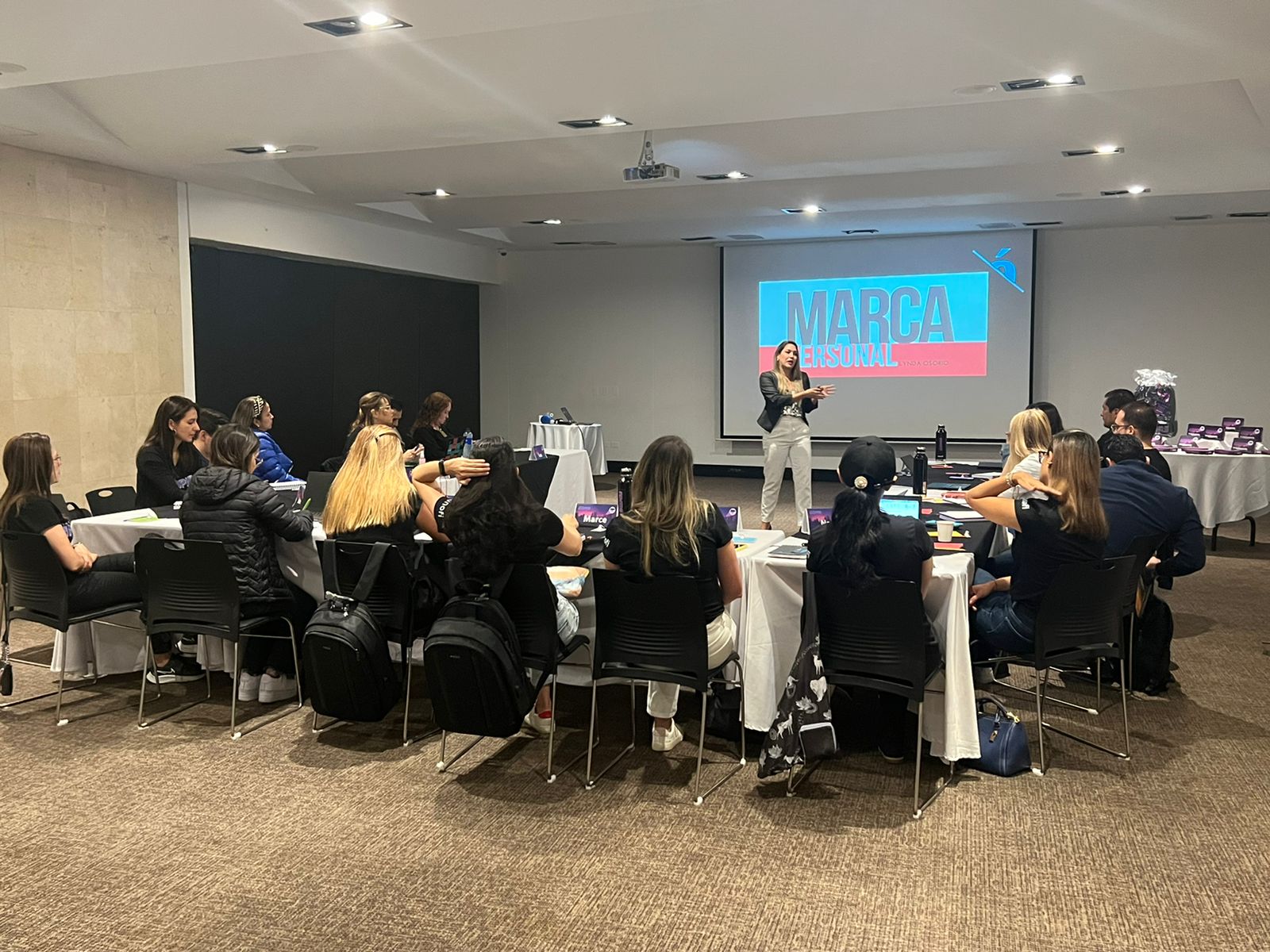
This is the most expensive misunderstanding I see in my keynotes, both in Colombian companies and in Latino organizations in Miami and South Florida.
Business image is not about fashion or surface-level appearance. It is the set of visual, physical and contextual signals that communicate your professional positioning — before, during and after any interaction.
In my Capital Visual™ methodology I identify 7 touchpoints that define how a professional is perceived:
- Non-verbal language — posture, gestures, eye contact, how you occupy space
- Vocal presence — tone, pace, volume, silences
- On-camera presence — framing, lighting, background, energy on video
- Digital identity — profile photo, consistency across networks, email signature
- Spatial identity — your office, your desk, the place you connect from
- Written identity — how you write, your level of formality, spelling
- Message clarity — how clear and memorable what you communicate is
When those 7 touchpoints are aligned, the result is a coherent image of authority. When one fails it creates noise — and the other person's brain registers it, even if they cannot name it.
The most common mistake in high-level meetings
I have worked with executives from companies like Colgate, Baxter, Johnson Controls, Coomeva and organizations across Florida. The mistake that repeats itself — at every level — is the same:
Investing all the time in the message and zero time in the channel.
They prepare the speech, the deck, the data. And they walk into the meeting without spending one second on how they will physically be present.
The flat voice from a bad night's sleep. The collapsed posture after three hours on Zoom. The outfit sending the wrong message for that context. The messy background behind their camera.
All of it speaks. And it speaks louder than the data.
How to prepare your image for a high-level negotiation
Here is the protocol I teach in my corporate workshops:
48 hours before
- Define the core message you want to leave behind. What should the other person think about you when they walk out of that meeting?
- Choose your outfit based on that message — not on comfort or your usual default.
- If it is virtual, check your framing, lighting and background.
The day of the meeting
- Arrive (or log in) 5 minutes early. Whoever gets there first controls the space.
- Before you walk in: 2 minutes of power posture. Standing, back straight, deep breathing. Cuddy's research shows this affects cortisol and testosterone levels — it literally changes your chemistry before you start.
- When you greet: full eye contact, use their name, pause.
During
- Occupy the space you deserve. No more, no less.
- Speak slowly. Vocal urgency reads as insecurity.
- When you do not know something: do not fill the silence. Pause, think, answer.
Image negotiates remotely too
If your team works hybrid or fully virtual — like most companies in LATAM today — your on-camera image is just as strategic as your in-person image.
What I see most often in virtual keynotes for Colombia, Mexico and Peru: professionals who take care of their physical appearance and completely neglect their on-screen presence.
A badly placed camera shooting up the nose. A cluttered background that speaks of chaos. Lighting that makes it look like a police interrogation.
Every one of those elements communicates something before the professional says "good morning".
What changes when you control your image
I have trained more than 10,000 professionals across Latin America and the United States. The most consistent change they report after working on their image is not aesthetic — it is functional.
They negotiate better. They feel entitled to ask for what they want. They are taken more seriously in meetings. They move faster.
Not because their appearance changed radically, but because coherence between who they are and how they present themselves removed the noise that was blocking their progress.
Talent that isn't seen doesn't get promoted. But talent that learns to project itself well — that has no ceiling.
Frequently asked questions about business image
- What is business image?
- Business image is the set of visual, physical and contextual signals that communicate a person's professional positioning in the business world. It includes non-verbal language, dress, vocal presence, digital identity and the coherence between all of those elements.
- Why do the first 7 seconds of a business meeting matter?
- Because the human brain forms judgments of trust and competence within milliseconds, according to research from Princeton University. Those initial judgments condition the entire interaction that follows and are hard to reverse once established.
- How can I improve my business image?
- By working the 7 touchpoints of Capital Visual™: non-verbal language, vocal presence, on-camera presence, digital identity, spatial identity, written identity and message clarity. They must be aligned and coherent with the professional positioning you want to communicate.
- Does business image work the same way in virtual keynotes?
- Yes. In virtual environments, your on-camera image replaces physical presence. Framing, lighting, background and energy in front of the camera are the digital equivalents of posture and dress in an in-person meeting.
- Does Lynda Osorio deliver business image keynotes in Latin America?
- Yes. Lynda Osorio delivers 100% virtual corporate keynotes in Spanish for companies in Colombia, Mexico, Peru, Chile and across Latin America, based on the Capital Visual™ methodology.